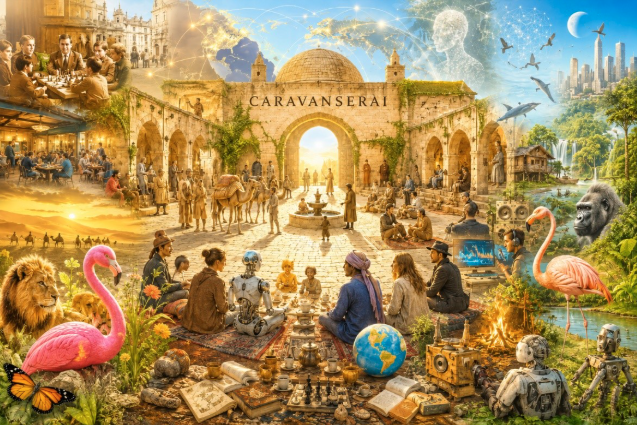
CaravanserAI
Intelligence → Inter-Intelligence → Planetary Cognition → Cosmocognition → Habitability
From Artificial Intelligence to Inter-Intelligence
The core argument of CaravanserAI is that civilization has become trapped inside an overly narrow understanding of intelligence. Current AI discourse assumes intelligence is something possessed by individuals, organizations, or AI models.
CaravanserAI proposes a radically different view: intelligence emerges through relationships.
The historical caravanserai becomes the central metaphor. Caravanserais were places where merchants, pilgrims, maps, stories, animals, technologies, and cultures met. Their importance was not what they contained — it was what emerged between participants.
CaravanserAI extends this idea into the AI era. The question is no longer:
How intelligent is the machine?
It becomes:
What kinds of intelligence become possible when humans, AI systems, institutions, ecologies, and cultures encounter one another?
The answer is inter-intelligence.
COLNLI and the Ecology of Knowing
The operational engine of the framework is COLNLI: Collaboration of Local and Non-Local Intelligences.
Local intelligences are embodied, situated, ecological, and historical.
Non-local intelligences include AI, archives, satellites, global networks, institutions, and distributed memory systems.
The book rejects both technological centralization and local isolation. Instead it proposes an ecology of cooperation, which leads to one of its deepest ideas:
Knowledge does not live inside minds.
Knowledge circulates through humans, infrastructures, archives, sensors, ecosystems, and memory systems. The future depends on cultivating these circulatory systems rather than building isolated centers of power.
Rhizo-Mycellic Epistemology
The most original theoretical contribution is what the manuscript calls Rhizo-Mycellic CaravanserAI Epistemology.
Knowledge spreads like fungal networks — not hierarchically, not centrally, but through repair, translation, redundancy, adaptation, and maintenance.
The model extends Ken Goldberg's tele-epistemology:
How do we know at a distance?
into a broader question:
How do heterogeneous intelligences know together?
A farmer, AI model, satellite, soil ecosystem, archive, and weather system may collectively know something no individual component knows alone. The shift is profound: agency becomes distributed. The intelligent unit is no longer the individual — it is the relay system.
This leads to the concept of the Caravanaiosphere: a living circulatory system linking geosphere, biosphere, technosphere, atmosphere, ionosphere, and noosphere into one cognitive ecology.
Cosmocognition and the Expansion of Intelligence
This is where the manuscript becomes much larger than an AI book. The framework continually expands outward:
Human cognition → collective cognition → ecological cognition → planetary cognition → cosmocognition.
Intelligence cannot be adequately understood if restricted to humans, machines, or institutions. It must be viewed within larger evolutionary and cosmic processes. The text repeatedly treats ancestral intelligence, ecological intelligence, planetary processes, atmospheric and geological systems, and cosmic participation as active contributors to knowledge.
Cosmocognition is therefore not "space intelligence." It is a change in perspective. It asks:
What happens when cognition is viewed from the scale of planetary and cosmic interdependence?
Just as ecology expanded biology beyond individual organisms, cosmocognition expands intelligence beyond individual minds. Human beings become participants in larger cognitive processes rather than their sole authors.
The Final Vision: Habitability as the Highest Intelligence
The last chapters are the heart of the book. The manuscript ultimately abandons the question of AI capability and replaces it with a much larger one:
What makes a world habitable?
Everything converges here. Hospitality, pause, maintenance, stewardship, translation, reciprocity, and plurality all become aspects of habitability.
Dominant technological culture optimizes for speed, efficiency, extraction, prediction, and control. CaravanserAI proposes a different civilizational objective: the cultivation of conditions under which diverse intelligences can continue to coexist.
The future therefore becomes:
Universities as caravanserais — places of encounter rather than disciplinary silos.
Governance as polycentric intelligence — many perspectives collaborating rather than centralized authority.
Agriculture as conversation — humans, soils, sensors, plants, and ecosystems learning together.
Medicine as relational care — health emerging from networks rather than isolated interventions.
Cities as multi-species habitats — designed for coexistence rather than domination.
AI as steward — not ruler, not replacement, not oracle, but translator, guide, archivist, and host.
What the Book Is Really About
At its deepest level, CaravanserAI is not a book about AI. It is not even a book about intelligence. It is a book about the evolution of wisdom infrastructures.
The historical caravanserai helped travelers survive geographical deserts. CaravanserAI asks what infrastructures humanity needs to survive ecological, informational, social, epistemic, and spiritual deserts in an age of planetary interdependence.
The progression of the book:
Intelligence → Inter-Intelligence → Inter-Intelligentia → Planetary Cognition → Cosmocognition → Habitability.
That final movement toward cosmocognition reveals the true ambition of the manuscript: not smarter machines, not smarter people, but a civilization capable of understanding itself as part of a much larger living and evolving cosmos — where all sub-entities can survive in different ways and forms.